You are currently exploring the Fundamentals Library, which is designed to provide a basic overview of the topics that are covered in other longer articles. This article is a part of the Progression section.
Calisthenics Training Variables
When we plan our training, after selecting a set of exercises through the exercise selection process, the next step is to program specific variables that add more specificity to the exercise description.
In terms of the most important variables, there are two qualitative and two quantitative variables that are present and should be controlled in every program.
Load and proximity to failure define the type of adaptations we stimulate, but also the extent to which we stimulate them. Volume defines the dosage of that stimulus, and frequency defines the time interval between two independent bouts of that stimulus.
In this article, I would like to take a closer look at the volume parameter and give you an overview as well as practical recommendations on how to quantify and monitor it.
The Concept of Volume
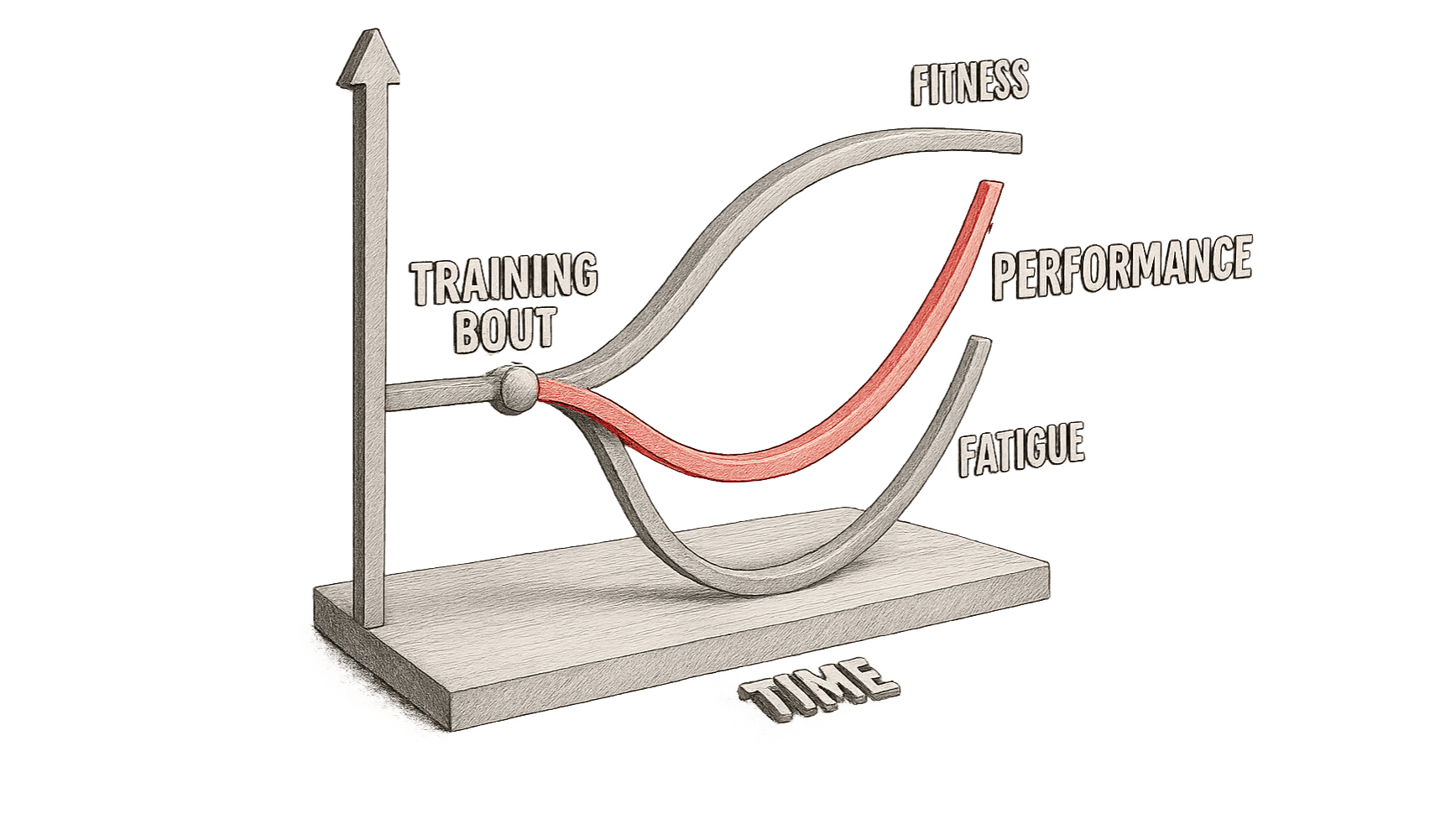
As the name implies, training volume describes the amount of exercise. For example, in aerobic training, training volume could be expressed in terms of distance traveled. The perspective that helps to understand the concept of training volume, just like any other training variable, is is that by manipulating it we aim to influence stimulus and fatigue.
Training volume however doesn’t qualify the stimulus, but rather quantifies it and determines what dosage we are providing to our body. This sounds like an easy concept to grasp at first sight.
There is however quite a large issue with measuring the volume of work we do, as we must be sure that what we are quantifying is the actual thing we care about. Let’s take a look at the popular ways of measuring training volume in resistance training.
Tonnage
The first, most general way of measuring training volume is through tonnage, also called volume load. This basically accounts for every single metric that we measure:
Sets × Reps × Load
Sets × Reps × Seconds × Load
These two equations can be used for determining tonnage throughout a given training organizational timeframe. In the first case we will get the number of kilograms/pounds. In the second case we will get the [kg x s] - a rather not commonly used unit in physics.
Let’s say I'm performing barbell overhead presses and I do 4 sets of 8 reps with 50KGs. My tonnage in this training session will be 1600 KGs.

The second, more granular approach of determining & measuring time under tension which includes seconds is very difficult to implement in practice. This is because the tempo of the repetitions (in the lifting phase) in most cases inevitably changes as we get closer to failure.
This method largely favors sets done with lighter loads, where we can accumulate more repetitions. With 30KG as opposed to 50, we could likely do 20 reps per set or so, and by the same token ger 50% more "volume".
Another feature of this method is that, as you can see, it doesn't take into account proximity to failure nor the relative load used. Everything is treated the same, just as a number. So, theoretically, I could take 10 KG, do a few hundred reps with it, and I would achieve some extreme volume during that session (though probably not equivalent stimulus).
Tonnage measurement can be problematic when we talk about calisthenics, as there are many exercises we do that are difficult to quantify in terms of objective load. While we could simply include our body weight in the formula, we can't account for other increases in exercise difficulty, such as range of motion or leverage.
This can also be overcome by adding certain coefficients to the versions of the exercise. This however increases the complexity of the whole method. For example, we could assume pike push up provides resistance of 50% of our bodyweight. Then for variations of these exercises we could add coefficients determining the load relatively to pike push up variation:
- Pike Push Up - [1.0]
- Elevated Pike Push Up - [1.5]
- Wall Handstand Push Up - [2]
The tonnage can also be tracked in a relative manner. The relative tonnage will simply compare sets, sessions or training weeks with each other and give you a percentage value:
- Week 1 - Baseline
- Week 2 - + 10%
- Week 3 - + 15%
The only way it can work, is if in the variables that we are comparing - the variables like exercise selection and relative load are the same. In that case it can give us a useful overview of the direction that our training is heading, in terms of the amount of work we do.
Hard Sets
The next approach is a bit more specific and refers to the number of hard sets performed during a given organizational timeframe.
This approach takes into account proximity to failure. A hard set can be defined as any set done with a proximity to failure of at most 3-4 reps in reserve. The idea behind this method is taking into account things that the previous method doesn't. Regardless of the relative load and the exercise, if the set is difficult enough, it will count as work done.

With this approach, the objective or relative load doesn't matter. What matters is that a set is performed at a high intensity in terms of proximity to failure. And only that set counts for the volume we accumulate.
Of course, the 5 reps in reserve is an arbitrary number here, and we could use another number for classification purposes in this approach.
This model equalizes sets with very high loads and very low reps. A set of 1 rep at submaximal load (1 rir) will provide the same "volume" as a set of 12 at 1 rir. It also equalizes sets taken away from failure with those taken to failure.
In exchange, we get a method that is very practical and easy to follow without too much maneuvering and calculation. We can simply count all the sets we do, excluding the warm-up. And we just have to make sure that we train hard enough in terms of proximity to failure.
Hard Reps
The third method of measuring volume is the extended version of the previous one, which is by measuring hard repetitions.
This model takes into account only the last few reps of a given set done to muscular failure. How many reps? This is not set in stone, but the typical number used is 5.
This means that if we do a set of 20 reps with a given load and that set is performed to failure, the volume of that set is 5 hard reps. The same happens if we do 5 reps set to failure or 30 reps set to failure. If we do the same set with 2 reps in reserve, that would mean we get 3 hard reps. If we strictly consider 5 reps, this means that if we do a set of 3 reps to failure, we will also get the volume equal to 3 hard reps.

As mentioned above, when measuring hard reps, you don't have to use only the last 5 reps before failure. We could use other numbers, such as 6 or 8.
This method doesn't favor low repetition sets (it actually decreases their ROI in terms of volume accumulation) and it also doesn't favor very high reps. Sets of 8, 12, 20, or 30 will have the same effect on volume provided they get to the same proximity to failure. This method also doesn't favor training away from failure in any way, as the hard sets method does. We get less volume by training away from failure.
This model can be a little less practical because it requires us to look at each set we do independently to quantify the number of reps.
Effective Reps/Stimulating Reps
The hard reps model is based on a specific model proposed by Chris Beardsley called stimulating or effective reps. Effective Reps is a model designed strictly for hypertrophy training, including the last few repetitions of a set done to failure.
The model is based on the hypothesis that hypertrophy can be stimulated by high mechanical tension - which is greatest when the contraction velocity is low - as the force-velocity relationship states as well as simultaneous high motor unit recruitment that correlates with the amount of effort - this ensures that the underdeveloped high threshold muscle fibers experience this tension).
A deliberate slow contraction with low weight will only produce high tension in the low threshold fibers that are already capped in terms of growth, but it will not stimulate meaningful hypertrophy because there is not enough effort to provide that tension to the high threshold fibers. On the other hand, a high-effort, rapid contraction (like a jump) will cause a high level of recruitment, but will not stimulate the muscles to grow because of the low tension.
Thus, the last reps to failure are the only valid method to achieve both at the same time. Therefore, the practical implementation of this method is similar to the hard reps model. However, it has very important implications that go beyond the mathematics of counting training volume.
The model extends to the idea that mechanical tension and motor unit recruitment can be undermined by the effects of fatigue. Therefore, it counts only those repetitions that meet the criteria of hard reps while also being performed in a non-fatigued state. This includes not counting reps that are performed:
- Following not adequate rest between sets
- Following adequate rest between training sessions
- In sets over 30 reps / with the load below 30% of 1RM
- After many sets already performed in the same session
The author mentions himself that 5 last repetitions seems to be a point where maximal recruitment is achieved and that’s why he chooses this number, but that the number can be slightly higher or lower depending on the situation.
This means that less advanced people are likely able to stimulate hypertrophy by training quite far away from failure. It also explains hypertrophy after a period of immobilisation, when even not externally loaded movement can stimulate hypertrophy.
Volume In Static Exercises
In calisthenics we perform many static exercises. The methods we have been going through seem to be designed for traditional exercises. We should therefore figure out the way to convert the concepts we talked about to isometric training.
In terms of tonnage, we can simply replace repetitions with seconds and get some sort of isometric volume load. In case of bodyweight skills, this is extremely difficult to measure because the resistance in these skills is usually manipulated by the moment arm. And at the same time, our weight fluctuates. So this can be very difficult to assess when it comes to isometrics. Probably using coefficients is the only way to go.
- Tuck Back Lever - [1.0]
- Advanced Tuck Back Lever - [1.5]
- Straddle Back Lever - [2]
Hard sets will definitely be possible to implement in isometric training. We can set it up so that hard sets are counted when we finish the set with a maximum of 5 seconds close to failure.
Hard reps could also be expressed in hard seconds, all you have to do is decide that we count the last 5 seconds of a set taken to failure (an arbitrary number that can be modified slightly). Then everything is the same as for reps.
With that adjustment, a 20 second hold taken to failure is quantified the same way as a 10 second hold taken to failure. When we add seconds in reserve, we subtract those seconds from the hard seconds. If we do a set with a maximum load of 3 seconds and we go to failure, we only accumulate 3 seconds of volume.
In my opinion, this is a decent conversion of these methods to isometric training that can be used in almost any situation.
Monitoring Volume in Practice
These are the most popular methods of measuring training volume. Unlike load or proximity to failure, volume is a more abstract concept. We count volume for a reason. We don't just want to track how much work we're doing, we want to track how much actual stimulus and fatigue we're giving our bodies, which can be very complex.
For this reason, each of the methods I've mentioned has its drawbacks and probably won't be a 100% accurate method, but they are a good place to start.
Tonnage is not a good predictor of hypertrophy or strength. This can be seen in the literature as well as in physiology. However, it can give us a general idea of how much we are training and how much stress we are putting on our connective tissue.
Hard sets can have their shortcomings, especially when we train over a variety of rep ranges and proximities to failure. Research typically uses the number of sets to failure as a measure of volume. Adding a concept of reps in reserve is also a very common practice. If we have a program that is fairly stable in its structure and includes training close to failure (1-2 rir), then this measurement is probably a very good metric we can use for hypertrophy training. It is simple, practical, and easy to monitor over time.
If our program is more diverse in training variables, hard reps would probably be a better model to implement to account for all the differences in potential stimulus from set to set.
What the stimulating reps model does is provide a helpful set of recommendations on top of the mathematical system of volume counting. It tells us that we probably don't want to accumulate too much volume in a training session, or that if we train too often, the reps will lose their effectiveness.
It's worth noting, however, that the exact mechanisms behind the stimulating nature of repetitions for hypertrophy are still unclear. The stimulating reps model denies the possibility that, for example, metabolic stress factors somehow contribute to hypertrophy. And while I prefer this explanation myself, I can't pretend to have all the answers. Mechanical tension is a safe bet, as researchers generally agree that it is the most potent contributor to hypertrophy.
Counting Volume For Separate Muscle Groups
While the models explain how to count the total volume, they don't explain how to decide whether a given muscle qualifies for that volume in a given exercise. While this is a very straightforward task in isolation exercises, it becomes a problem in compound exercises. And this problem doesn't have a perfect solution. We are forced to make certain simplifications and assumptions.
You could also say that if you have this problem, it means you've done a bad job with exercise selection, which is a more fundamental area of programming than variable selection, which can't be fixed with anything above it in the decision pyramid.

This may be true depending on the context. If we were training for hypertrophy and maximizing our stimulus, we would probably choose exercises that were very direct and not diluted in terms of tension distribution. And then the problem discussed in this section would essentially not exist.
However, many people either want to save time, make their training partially strength oriented (in certain lifts), or simply make it more athletic/fun and not strictly bodybuilding style. In this case, the problem exists and we need to do something to mitigate its negative effects on our monitoring of training stimulus.
Among various approaches, some of them include counting the full stimulus (for example, 1 set) for the prime movers and half of the stimulus (for example, 0.5 of the set) in case of supporting muscles that also participate in the exercise and get tired, but are not the limiting factors. For example - anterior forearm in pull-ups (due to grip).
Other models dispute this idea and practice a binary approach, the exercise either stimulates the muscle and can be counted for it, or it does not. Most commonly, we only count the volume for prime movers.
For example, vertical pushing exercises will target the deltoids, clavicle pecs, and triceps. On the other hand, horizontal pulling exercises will target the upper back, lats, and biceps. The individual contribution can be changed by adjusting the technique of an exercise.
I personally use the binary approach, for three reasons:
- If we do 20 reps of an exercise with 10 reps in reserve - we will feel that muscle a little bit after the set albeit not get any stimulus for its growth. The same happens with the muscles that are not limiting factors in an exercise
- This approach forces us to do a good job with exercise selection
- It is more practical (easier to implement)
However, we must take into account that our stage of development will influence it greatly:
- An early novice can target their bicep with any bent arm pulling exercise
- A later stage novice will target the bicep in pulling exercises when using underhand grip only
- An early post-novice will need to include some kind of curl, but any curl will target the bicep
- A later post-novice stage athlete will need to perform a specific curl variation with supinated grip focused on the bottom part of the motion where bicep is most active
You can use the example above for any other type of exercise. Simply determine where you are and adjust the model of counting volume towards it in your compound exercises.
Volume in Strength Training
The models we have gone through are designed to standardize the way we count the work we do, so that we can control it and modify it based on feedback or a programming idea. However, these models are not necessarily created with strength as a goal in mind. If our goal is strength (which is the case for most calisthenics athletes), we need to supplement our volume counting model with strength specific measures.
As we know, strength and hypertrophy are closely related. However, to build strength, we need a specific stimulus, both in terms of exercise selection and load. Assuming these are checked off, we should count the specific work we do within a certain organizational period.
In strength training, what matters is a quality set. A high quality set does not necessarily have a high proximity to failure, although that will be the case regardless if we train with high loads. Rather, it is a set done with full concentration, attention to detail, and effort put into each repetition or second. Furthermore, as the stimulating reps model suggests, this set should not be performed in a fatigued state.
In practice, I typically use a hybrid approach when working with our clients. I count the main and supplementary exercises specific to a particular skill and treat them as a separate category where a certain volume threshold is required (and should not be exceeded) - I do this through the number of specific sets.
Then all other work is done strictly for the sake of stimulating hypertrophy - I personally use a hard sets model. However, I do this because the programs we write typically allow for it (they include consistent loading and high, consistent proximity to failure).
Here's the catch, though. While hard sets for hypertrophy don't really account for specific strength work (they contribute to strength, but it's not specific work required), specific strength work does account for hypertrophy work (and the fatigue associated with it).
That is, after analyzing the prime movers in the specific exercise, I add it to the volume for those muscle groups. However, if the sets are low reps (1-3) and/or the exercise is more technical in nature, I count it as half of the set. Let's look at this example:
- Handstand Push Ups x 4 sets x 2
- CTW Handstand Push Ups x 2 sets x 5
- Dips x 3 sets x 8 (1 rir)
- Lateral Raises x 2 sets x 10 (0 rir)
- Tricep Extensions x 2 sets x 10 (0 rir)
Handstand push ups are treated as 2 sets for triceps and deltoids. CTW Handstand push ups are treated as full sets, because 4 reps is already higher and the nature of exercise is such that it can be more stimulating for hypertrophy. In this case I get:
- 6 sets of specific handstand push up work
- 6 sets for anterior and middle deltoids
- 9 sets for triceps
- 3 sets for pecs
I think this is the only valid implementation of counting “half of a set” as a volume. The nature of the reps is still very stimulating, but we just get less of them. It is not the same thing as counting half a set for a muscle that is not the limiting factor in an exercise. That muscle will not get full recruitment, and therefore likely not experience much growth (unless we talk about the beginners population).